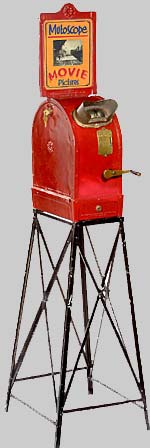
In 1894, the American Hermann Casler invented the Mutoscope. It was the first machine that applied the simple principle of persistency of vision studied by Muybridge and Marey. Casler put together on a wheel mechanically leafed through pictures taken with a Mutograph (one of the first photo cameras). After eventually inserting a coin in the device, when turning the handle at the speed of 16 to 18 pictures a second, you give the illusion of motion. Two Americans, Coleman Sellers and George Burnham, patented as soon as 1861 a device called Kinematoscope that anticipated this principle but was based on stereoscopy (invented in 1832: when looking at two slightly different pictures, you see it in three dimensions). The Mutoscope was in a way the first flip through machine or viewer. Even if it was not a flip book that the device flipped over, the other machines after all followed this very simple principle. Casler registered a patent on 21st November 1894 in the US, accepted on 5th November 1895.
The Mutoscope knew a quick success in the US in what we call the ” Penny Arcades “, a sort of gaming room of the time. In England, they called it after one of its most famous picture wheels: ” What the Butler Saw “. It was very popular until about 1910, when competition with movie shows became disastrous for it, even if it was still in use afterwards.

On 30th July 1895, Hermann Casler registered patents in Paris (n°249.286) and London for what he still called a Mutoscope, but in an extremely simplified version, closer to what we later on called a “viewer”, a simple flip through machine. On 4th May 1897 in France and 19th May 1897 in England, he patented again for improvements of his Mutoscope.
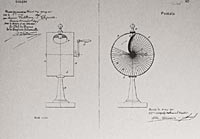
On 10th August 1896, Charles Auguste Watilliaux and Siméon Claparède got a patent in Paris (n°256.039), for a “device giving the illusion of movement through the quick succession of photographs or drawings”. He used the chronophotography of Georges Demeny. The illustrations show clearly the working of the device. It was probably the first device of a small size that applied with a very simplified system the principles of the Mutoscope 1. Charles Auguste Watilliaux developed his folioscope earlier (see our History section) and foresaw that he could apply the device “to photographs or drawings displayed on a cylinder like the system of books known for a long time under the name of magic books, which edges are cut in a way that when you flip over here or there, you see this or that subject”. He compares it to the Magic Books, but we already mentioned how far they are from the flip book, the act of flipping through excepted.
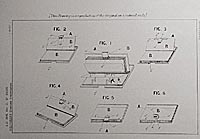
On 11th September 1896, the Englishman Arthur Andrew Melville — who ten years earlier had patented a project for a “Living Picture Book” — registered another patent (British Patent, n°20.136) entitled “A New Device by which the Leaves of Picture and other Books may be Turned Over in a Regular Manner“. It was this time, as the illustration shows very clearly, a very simple system to flip over a real flip book.
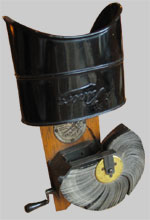
Auguste and Louis Lumière invented the Kinora, patented in England in 1896. It was in a way a simple by-product of the Mutoscope: it had a handle too (but no need to insert a coin) and a smaller picture wheel. There are many versions that only differ in the way they look. Negatives of the first movies directed for the cinema supplied the production of pictures until World War I. An inventory was recently re-published 2.

On 17th August 1897, Charles Auguste Watilliaux got a new patent (n°266.424) for an almost identical device to the one of the year before, but this time called “Cinébaroscope”. The main difference was that a mirror reflected the pictures so that the user could see them through a little window.
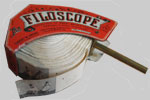
In 1898, the Englishman Henry Short patented what he called the Filoscope, a kind of mini-Kinora with no handle anymore. The hand turned the pictures’ rack which was now flipped through only by a metal piece. Images are not on a wheel anymore: we are closer to the actual flip book.
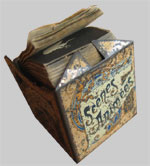
In 1898 appeared a French viewer patented by a flip books’ manufacturer named Léon Beaulieu (patent of 9 March 1898). He called it “Effeuilloir mécanique pour cinématographe de poche”.
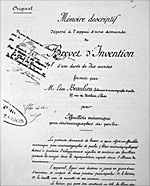
He made it to really flip over a flip book that you inserted inside and that, as for Short’s Filoscope, only the hand could handle. Probably at the same time, Léon Gaumont invented another flip books’ viewer. He also realized a more sophisticated version of the Filoscope that he called “Kinora à main”, adding a handle to hold it and a magnifying glass for a better vision of the photographs. There is a copy of both Gaumont viewers at the Musée des arts et métiers in Paris 5.
In 1900, a French toy manufacturer produced a “Cinématographe” whose pictures were assembled on a continuous loop strip and activated by a handle inside a parallelipedical cardboard box.
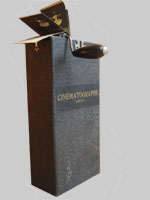
A ball placed inside puts pressure on the pictures’ strip. The pictures go up successively when using the handle, giving the illusion of motion. Our copy is not in its original box, but according to Pascal Pontremoli 3, the instructions stuck inside the lid are in three languages — French, English and German — and specify: “The Cinématographe-Jouet is the most simple and efficient device made until today to reproduce animated scenes.
To turn it on, you just have to put on the winch the selected collection, insert the counterweight ball and leave the whole thing inside the device.
Always hold the Cinématographe-Jouet vertically“.
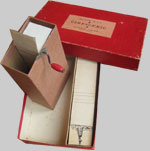
Another version, presented in a red box, is called “Cinescenic – Dessin animé” and manufactured by Jouets R.J.L. The box is brown and the strips inside are drawings that can be considered as an ancestor of the cartoon. The use of the words “Dessin Animé” suggests it was produced several years after the other. Instead of a ball, the counterweight is a metal cylinder.
In 1905, an electric version of the toy was produced and promoted in catalogues under the same name of “Cinématographe-Jouet”: “Electric engine activating a cinematograph. 5 different views, batteries and accessories. Height 0 m 20. Length 0 m 27 4.”
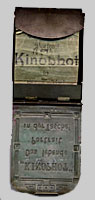
Two other small hand viewers appeared at the beginning of the 20th century. One is German, dated 1913, called “Kinophot. Das lebende Portrait in der Tasche”, published by Samson & Cie; it holds a flip book realized according to the Biofix principles: a series of photographs of ordinary people who went to the photographer and animated themselves, talking or gesturing in front of the camera. Once open, the case transforms into a viewer thanks to a moving part that animates the flip book.
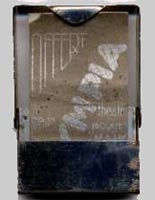
The second one is even simpler, as it is just a metal frame with a mobile part allowing flipping through the flip book inside. Found with a flip book of the Olympia theatre Jacques Haïk inside (same conception as Biofix’s), it probably dates from the end of the 1920s because Jacques Haïk took over the Olympia in 1929 to transform it into a movie house and had severe difficulties as soon as 1931.
American “Viewers” designed for children are also from the beginning of the 20th century. The first one ever mentioned is a make-it-yourself Mutoscope: “A Mutoscope for Boys and how to make it” by Theodore Brown, which appeared in Boys Own Paper on 16th–23rd February and 9th–16th March 1901 6, using Gies & Co flip books (such as The Yankee Cop).
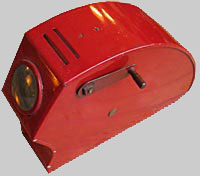

They extended after World War I. Midgette Toy, established in Boston, realized and distributed most of them, probably in the 1920s or 1930s. On the wheel activated by a handle, we can insert four flip books that we flip through one after the other to follow the action.
The drawings are from an unknown illustrator, probably an employee of the company. They sold the viewer with four flip books and proposed another box of eight extra flip books. We also found a copper negative shot that was used to print the covers of these flip books.

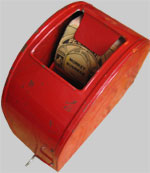
Another American toy manufacturer, Peco, established in Groton near New York, also used some of these flip books. The “Peco Movie” viewer is built on the same model and also allows leafing through four flip books. Only the shape and the handle are different.
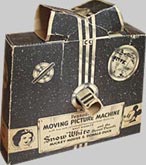
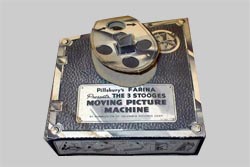
In 1937, the brand Pillsbury Farina proposed a cardboard flip through machine in kit form. Assembled without glue, the brand offered it to customers who bought its products. In 1938, Pepsodent proposed the same with recto verso pictures of two stories, Snow White and the Seven Dwarfs and Mickey Mouse & Donald Duck, under Walt Disney copyright.
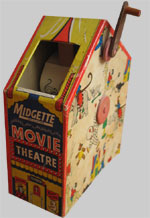
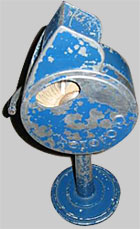
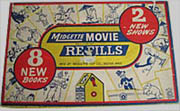
Midgette released a cardboard version of its viewer (copyright 1942) called Midgette Movie Theatre. It was the same principle as the metal version and Midgette re-published the same flip books. In the same way, they proposed an extra box with the same style of drawing as the viewer.
This German viewer called Rotofoto also probably dates from the interwar period. It is a kind of small Mutoscope: the pictures are on a wheel and flipped through with a small handle.
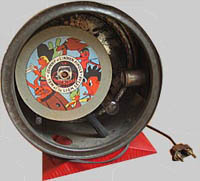
The French “Cinécoloral” probably dates from the 1950s. Like the Mutoscope, it uses the principle of the wheel with a light inside and can flip over what is like a real cartoon. However, unlike the Mutoscope, it projects the pictures onto an outer surface thanks to its lens, allowing several people to watch at the same time.
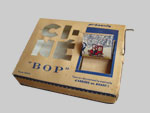
Around 1955 appeared a box that incorporated a folioscope with a handle, made by Carlier, a cardboard manufacturer in Fourmies (Nord, France). He called his “boîtes-à-jouer” “Ciné “Bop”“. Made of soft cardboard and filled with candies, the windows with rhodoïds allowed looking inside. A wire handle that moves the pictures around the axis activates the folioscope. Étienne Roth drew the pictures. According to Pascal Pontremoli 7, there are at least eight different ones: “Dans l’astronef”, “Le Satellite artificiel”, “Les Martiens arrivent”, “Hep ! Taxi”, “Be-Bop”, “Le trésor de la mer”, “Guerre dans l’espace” and “La fusée interplanétaire”. We found the first six.
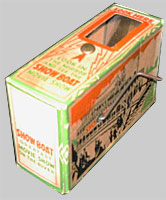
Of the same years is the viewer ” Show Boat ” made of cardboard by the Anchor Manufacturing Company established in Springfield, Missouri. There is a rolled pictures’ strip inside that a handle activates.

More recently, Kellogg’s distributed with its products a make-it-yourself viewer, almost identical to Pillsbury Farina’s and Pepsodent’s, only slightly smaller.
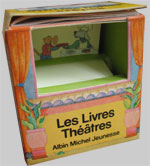
In 1984, the company Intervisual Communications Inc. of Los Angeles commercialized some “Livres Théâtres“; Albin Michel Jeunesse published the French version. There are three. The pictures’ wheel is simply activated with a finger.
In 1990, the monthly children’s magazine Schtroumpf offered in its 10th August issue a “schtroumphoscope” in kit form 8. It is a viewer whose recto verso pictures turn around a pencil, on the same principle as the one made by Kellogg’s.

Artists have also realized viewers or mutoscopes. We saw one in the exhibition “Daumenkino. The Flip Book Show” presented in Düsseldorf in 2005, realized by Robert Breer in 1964. Another one is reproduced in the catalogue; it had been part of an exhibition at the Whitney Museum in New York in 1980.
In the 1990s, Norman Colp realized some mutoscopes that took over some of his flip books from the end of the 1970s. They are extremely well finished and work to perfection. Some are unique pieces and others were produced in editions of 10 copies. Here attached, the copy from our collection takes over the flip book Steam: My View from P.S.1. It is a unique piece, realized in 1994.

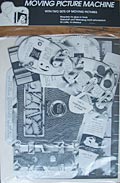

At the turn of the 21st century, we could find three viewers in kit form. Derek Read in England realized the first one in 1996; it is a mutoscope that he curiously called a “Mutascope”, distributed by Robenau Toys. The second one, in black and white, produced by the Deutsches Filmmuseum of Frankfurt and dated 1997, called Moving Picture Machine, is exactly the same as Pepsodent’s and Kellogg’s. The third one, also German, produced under the name Papier-Kino by Bären Presse in 2001, is very original (www.baerenpresse.de).
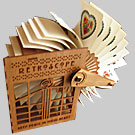
Finally, an American optical toys enthusiast, Joe Freedman, proposes these entirely handmade viewers with several versions of pictures to animate (www.sarabande.com). (See animation)
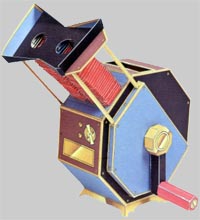
Also in 2001, the famous comic artist Chris Ware, author of Jimmy Corrigan, published in the n°15 issue of his magazine The Acme Novelty Library, a “Professional Futuristic 3-D Picture Viewer” to cut out and assemble, with a very original shape.
1: Mentioned a few months later in “Le folioscope mécanique”, La Nature, supplément au n°1232, 9 janvier 1897.
2: The Kinora Library. A descriptive List of Moving Pictures that you may see in your own home, Hastings, The Projection Box, 2001. See also Barry Anthony, The Kinora. Motion pictures for the home 1896-1914, London, The Projection Box, 1996.
3: Pascal Pontremoli described the toy in “De l’animoscope au zootrope”, Le Vieux Papier, 1997.
4: Found in Catalogue Jouets Étrennes 1906 des Magasins Aux Trois Quartiers by Pascal Pontremoli, op. cit.
5: See it in the section Communication of the Museum under inventory numbers 16964-0001 and 16964-0002.
There is also another version of the Kinora à main at the Gaumont museum.
6: Described by Stephen Herbert in Theodore Brown Magic Pictures. The art and inventions of a multi-media pioneer, London, The Projection Box, 1997.